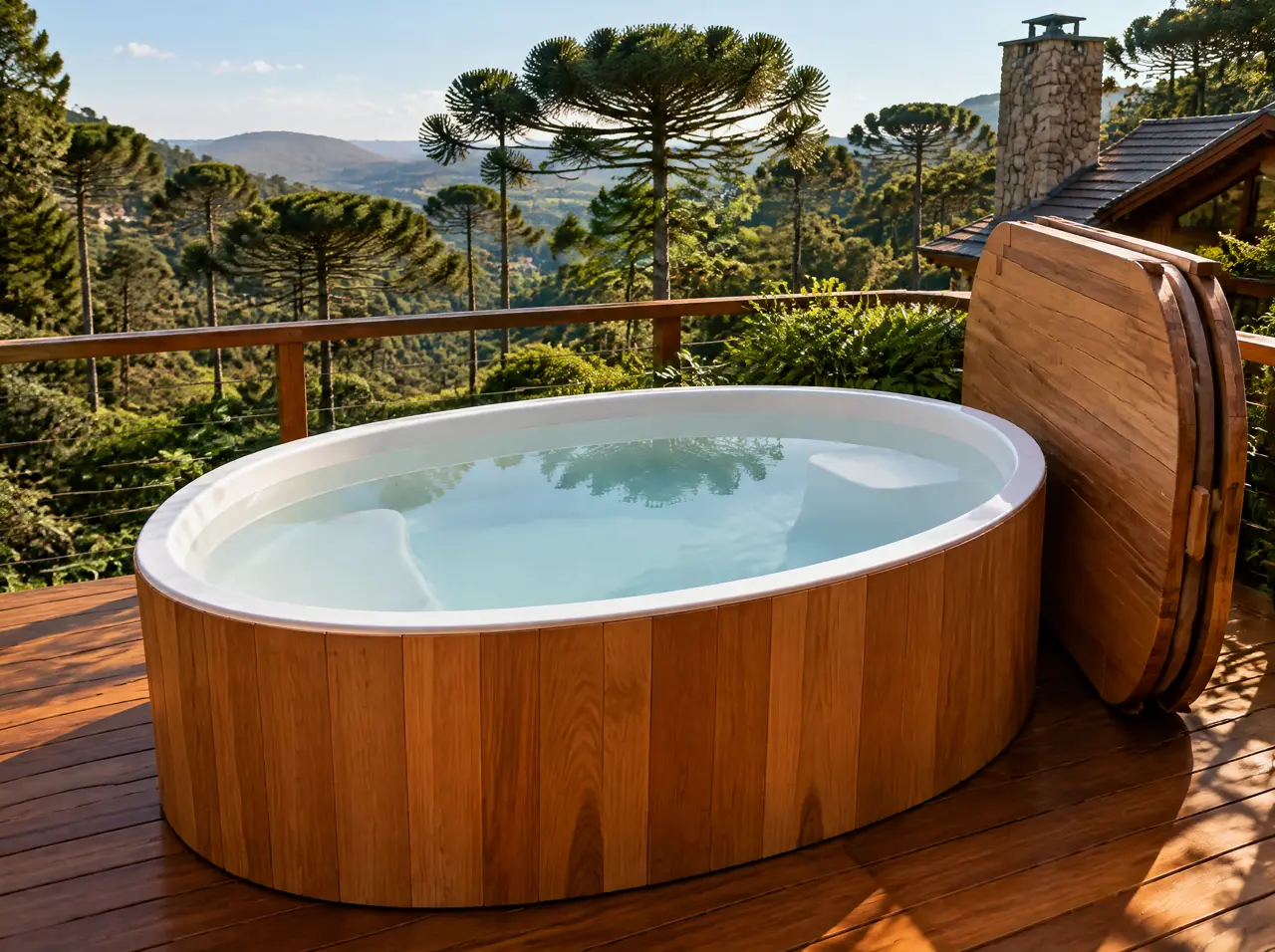
The ofuro came into Brazilian homes through Japanese culture and stayed for the feeling: hot water up to the shoulder, warm timber at your back, open sky. Our heated wooden tub is that ritual with the right engineering - an inner liner that keeps the water off the timber, a heater sized per litre and a cover that holds the evening's 38 °C through to morning. Residential use only: timber is made for a family, not for a queue.
Ash staves, a white liner and a heater under the deck
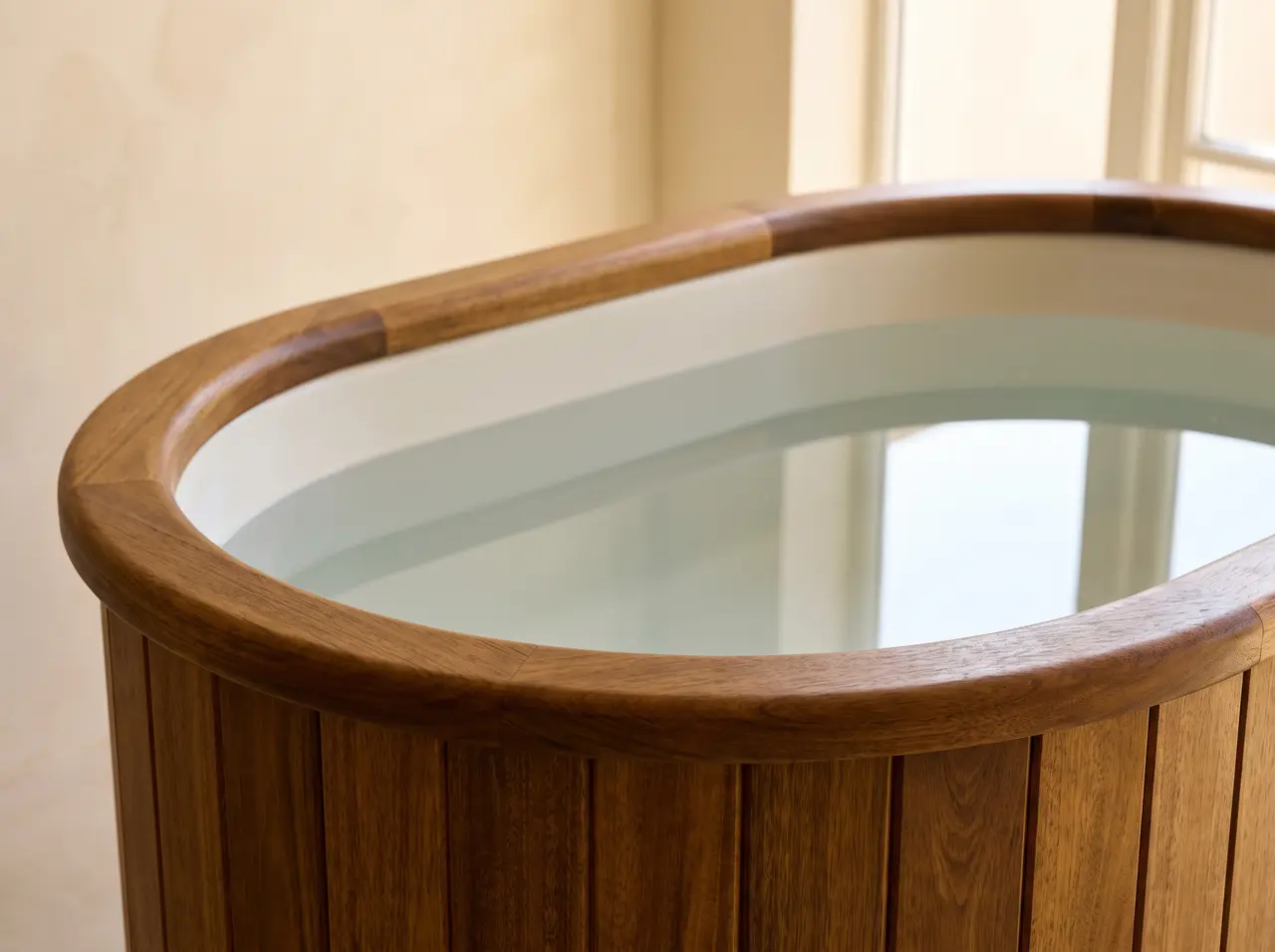
- Thermally modified ash staves (honey-coloured, stable in the sun) or pale cedar, machined to close by interlocking joints - which is why there is no metal band around it. What you see is only timber.
- A white fibreglass liner moulded inside, with two to six seats at different heights: the water covers the shoulders of someone 1.90 m tall and doesn't drown someone of 1.60 m.
- A 6 to 12 kW electric heater with pump and cartridge filter, mounted in a service box under the deck or in a cabinet alongside. Only two low pipes leave the tub, at the back.
- A rigid thermal cover with a handle: without it, the water loses 1 °C an hour on highland nights; with it, under 2 °C by the next day.
- Firewood: the submerged wood stove exists and has its charm - but in condominiums and urban areas it won't pass the by-laws. On a farm, ask us: we draw the wood-fired version.
We measure the people who will use it, not only the deck: seat heights and water depth come from the household. That is why the same 1,400-litre tub comes out differently for a family of 1.90 m surfers and for a couple of 1.65 m - and nobody ends up with water at the chin or at the navel. The drawing goes into the 3D design, with the cover and the service box in place.
Wooden tub or acrylic hot tub? Still water versus jets
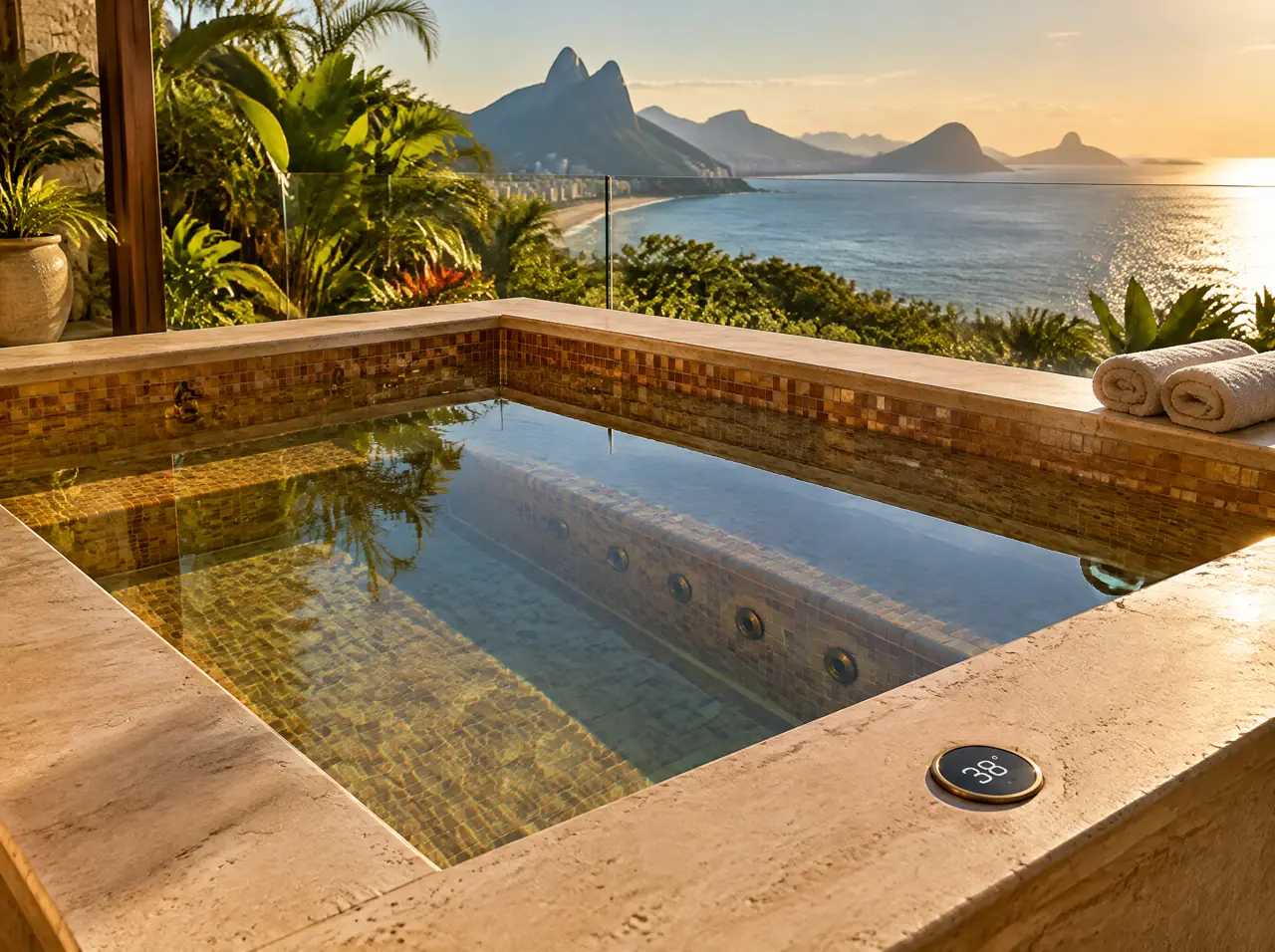
The hydromassage hot tub is a group, jets and terrace works. The wooden tub is still water, quiet and the deck of a house - two people talking softly with their feet out. It has no jets (the pump only filters), weighs under a tonne full, arrives ready on a truck and asks for no civil works: a level floor, a drain nearby and a 220 V point. And it costs less than half. Those who want both worlds usually put the wooden tub in the garden and the hot tub on the penthouse terrace.
Highlands, coast and countryside: the climate sets the kW
- Campos do Jordão, Gramado, Curitiba and the Minas highlands: the hot tub is the winter product. With 5 °C outside and 38 °C in the water, the 9-12 kW heater and the cover are the difference between a calm electricity bill and a fright.
- The coast and Rio: water comes in warm from the mains and the heater almost rests - here the cover is more against leaves and rain than against the cold. Thermally modified timber takes sun and salt air.
- Inland São Paulo and farms: well water with iron stains the white liner within weeks. We test the water and fit a pre-filter before the first fill.
- Electrics: 6 kW runs on 220 V two-phase - in São Paulo, Rio and Curitiba (the supply there is 127 V) we ask for a dedicated 220 V circuit; 9-12 kW may call for three-phase. In Floripa and Brasília the mains are already 220 V.
Hot today, contrast tomorrow: the pair on one deck
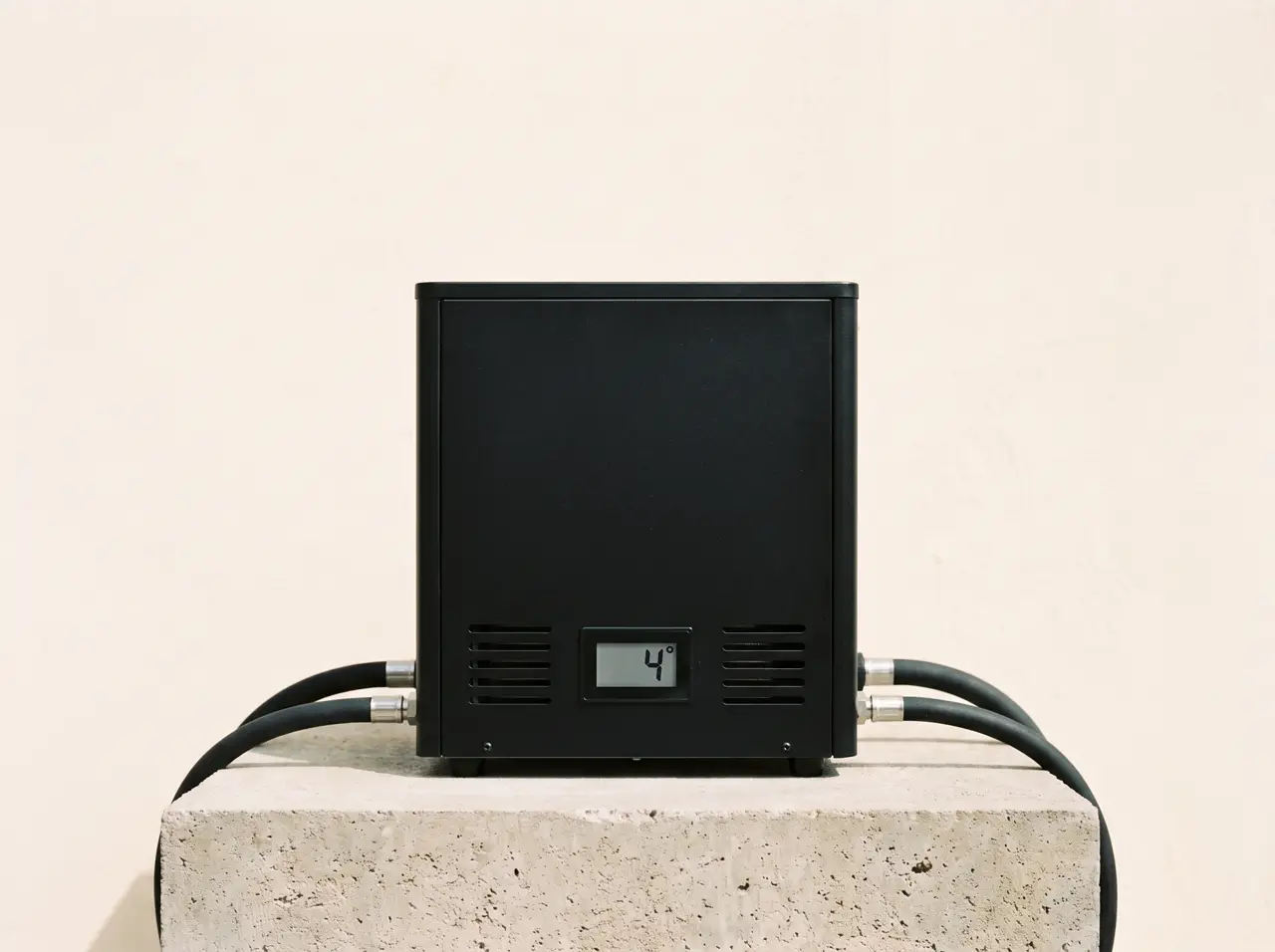
The question that always comes: "can the same tub be the cold one?" Technically yes - the shell is the same one as in the ice bath - but heating and chilling 1,400 litres on the same day costs energy and patience. What works is the pair: the heated 1,000-1,400 L and the cold 420 L oval with a chiller beside it, on the same deck, in the same timber. Five minutes at 38, two at 4, repeat. We leave the cold one's connections planned even when you start with the hot one alone.
How much does a heated wooden tub cost?
R$ 22-34k for the 1,000 L for 2-3 people, R$ 30-45k for the 1,400 L and R$ 42-60k for the 1,800 L for 6 - with heater, filter, cover and basic installation. Indicative ranges; the firm number is set in the free 3D design.
How long until the water is at 38 °C?
From 18 °C to 38 °C, a 1,400 L tub with 9 kW takes about 3.5 hours. That is why it stays on in maintenance mode with the cover closed - holding the temperature costs far less than reheating.
How much electricity does it use?
In maintenance mode with the cover on, 3 to 6 kWh a day in a highland climate, less on the coast. We hand you the kWh/month estimate for your city in the design, before you sign.
Why homes only?
Timber and liner work well with one family; with a queue of 30 people a day, they don't. For hotels, clubs and gyms the road is the masonry hot tub or the hot and cold pools - see for businesses.